


Although photographing plants is less popular than photographing flowers, it has fans. Flowers are colorful and have a complex geometric shape, stimulating the mind. On the contrary, plants without flowers have fewer colors and are primarily green. Still, this simplicity, if combined with the skill and art of the photographer, creates captivating images. In this article, we will discuss close up plant photography.
Topics
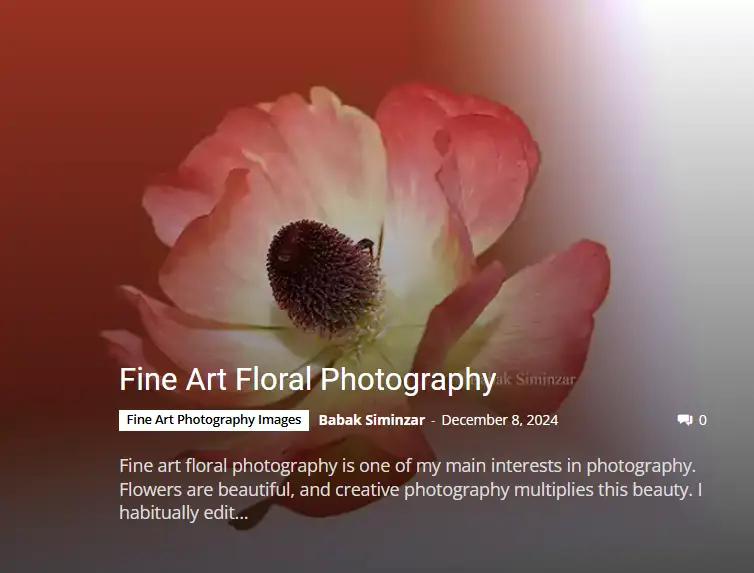
Please look at the Fine Art Floral Images Gallery for more

Look for plants with specific shapes
Don’t expect success in this field just by taking pictures of a few leaves. People see a lot of leaves around them, which is not considered a significant point for them. It is better to try to look for plants with a specific shape; cacti and mushrooms are good examples of this.
If the plant only has leaves, the shape of the leaves should be unique and different from other plants.


Best focal length for close up plant photography
This issue depends on the size of the plant and its leaves, and the other is your goal. If the plant and its leaves are large, using a standard lens of 15 to 50 mm is better. Indeed, your distance from the plant will be a little more in such a case.
But if you want to take pictures of leaf veins or water drops on the leaf, or if your subject is a small mushroom, it is better to use a macro lens with high magnification.
With a 105 mm macro lens, you can take photos from a distance of one meter; on the contrary, with a 35 mm macro lens, you can take pictures from a distance of 15 cm from the plant.


Camera setting for close up plant photography
Settings can be different depending on different situations.
If you want to shoot a bush with many leaves, shoot at a narrow aperture with a slow shutter speed and a tripod. A tight aperture will capture the leaves’ details and give you a sharp background. However, due to the narrow aperture, you may have light problems and have to reduce the shutter speed. Slow shutter speed and the possibility of a handshake may require you to use a tripod. This approach reflects the essence of fine art macro photography.

If you want to photograph the veins of a leaf, a small plant, or water drops on a leaf, I recommend using a wide aperture with a high shutter speed. A wide aperture will blur your background and give it a dreamy look. It will also enable you to use low light. Light is a critical element of close up plant photography.
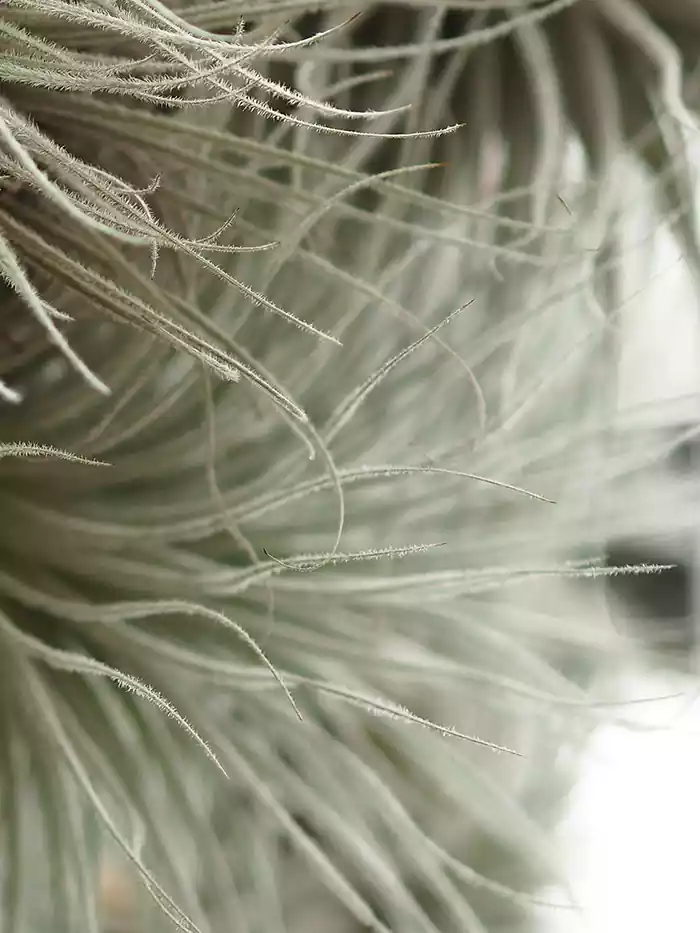

A high shutter speed reduces the possibility of blurring, which is a valuable advantage in close up plant photography.
The slightest movement and vibration can destroy the sharpness and clarity of a close up photo.
Using low-key photography and a dark theme
This method has recently been welcomed for photographing plants and flowers, especially roses. In my experience, it works excellently in leaf photography, especially in black and white style.


Finally, pay attention to the composition
Composition is a fundamental principle in all styles of photography. Still, I recommend you take it more seriously when photographing plants because you no longer have beautiful flowers at your disposal and cannot show off their beauty.
The composition has a direct relationship with the three-dimensional shape of the plant. Whether you want to show a bush full of leaves in the close up photo or place the part of the stem from which the branches were separated in the center of the image. Or you want to Record the details of a leaf in the plant’s environment.
Good Luck

Download this tutorial for free: 5 Close up Plant Photography Tips PDF
